

Introduction
Victoria is one of Australia's fastest-growing states, and the development pipeline reflects it. Population growth, infrastructure investment, and land release activity are concentrated across a set of well-defined corridors and regional centres, each at a different stage of maturity.
For developers and investors, the opportunity is real, but so is the competition. This guide provides a practical framework for assessing Victoria’s highest-growth regions, covering how to read the key metrics, understand corridor dynamics, and align acquisition and delivery strategies with confirmed infrastructure and planning outcomes.
How to identify high-growth development regions
Not every fast-growing region is a good development market, and the difference shows up in the data. Population growth and migration trends provide the clearest signal of underlying demand, while dwelling approvals and building activity indicate the scale of supply already entering the market.
Infrastructure plays a decisive role. Regions with confirmed transport upgrades, road improvements, or major employment investments tend to experience stronger and more sustained demand, and the timing of those projects directly influences absorption rates and pricing outcomes.
Land price trends need to be read in context. Rapid price growth can signal strong demand, but it can also compress margins if not supported by continued population growth and infrastructure delivery. Planning complexity, including overlays and environmental constraints, adds a further layer of cost and timing risk that needs to be factored in from the outset.
Understanding Victoria’s growth corridors
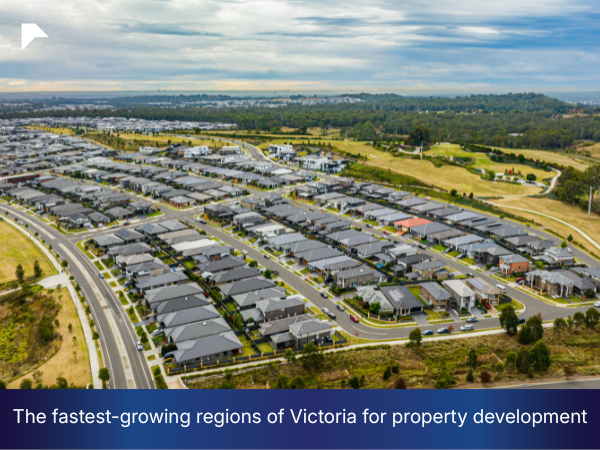
Melbourne's outer growth corridors remain the engine room of Victorian suburban development, but each has its own character and risk profile.
The western corridor, particularly Werribee and Tarneit, continues to deliver large volumes of new housing driven by strong population inflows and major transport investment. These locations offer genuine scale, but require careful staging to manage periods of elevated supply and the absorption pressure that comes with them.
The northern corridor, including Craigieburn and Wollert, is supported by affordability and expanding transport links. Demand here is closely tied to household formation, with first-home buyers and families the dominant market. Margins can be attractive, but they are sensitive to construction costs and the pace of sales absorption, making conservative modelling essential.
In the south-east, suburbs such as Cranbourne and Clyde continue to expand through staged precinct developments. Infrastructure delivery is the key value unlock in these locations, and timing acquisitions to align with funded projects can materially improve outcomes.
Regional cities as development markets
Victoria’s regional cities have established themselves as markets with genuine depth.
Geelong, particularly the Armstrong Creek corridor, has evolved into a significant growth area supported by lifestyle migration, local employment, and proximity to Melbourne. Demand draws from both local buyers and commuters, and feasibility models need to account for those different buyer profiles and their varying price sensitivity.
Ballarat presents a more affordability-driven opportunity, with steady demand underpinned by growth in health, education, and local services. These markets tend to offer more stable absorption than outer Melbourne corridors, but remain sensitive to shifts in local employment conditions and the pace of infrastructure investment.
Emerging regional areas carry a higher risk, particularly where demand depends on a single industry or project. These locations warrant a cautious approach and require clear, sustained evidence of demand drivers before capital is committed.
Aligning development with planning frameworks
Precinct Structure Plans and local planning schemes provide the framework for how development occurs within growth areas. These documents outline staging schedules, infrastructure responsibilities and environmental constraints, all of which influence project feasibility.
Understanding how to interpret these plans is essential. Staging schedules indicate when land can be developed. Infrastructure requirements determine both cost and timing. Environmental overlays, covering flood risk, vegetation controls, and similar constraints, can reduce net developable area or introduce costs that don't appear in headline land pricing.
Early engagement with planning authorities clarifies these factors and surfaces potential issues before acquisition, when it is still possible to walk away or renegotiate terms accordingly.
Infrastructure as a value driver
Confirmed infrastructure is one of the most reliable indicators of sustained development demand. Transport projects, such as new rail stations and major road upgrades, improve accessibility and increase demand. Investment in health, education, and employment precincts supports long-term population growth and gives buyers confidence in a location's future.
The key is to focus on projects with confirmed funding and clear delivery timelines. State budgets, infrastructure plans, and formal agreements are the verification standard. Aligning development staging with those timelines reduces risk materially and improves the likelihood of achieving target returns in the window when demand is strongest.
Applying feasibility discipline
Feasibility analysis should be grounded in realistic assumptions and tested under multiple scenarios. Key inputs include land acquisition costs, construction expenses, infrastructure contributions and projected sale or rental values.
Margins in suburban developments are particularly sensitive to changes in build costs and sale prices. Even small variations can significantly affect profitability, making sensitivity analysis essential. Testing scenarios such as increased construction costs or slower sales absorption helps identify potential risks early.
Financing considerations also play a role. Pre-sales requirements, interest rates and investor sentiment can influence both project viability and delivery timelines. Incorporating these factors into feasibility models provides a more accurate assessment of risk.
Managing development risks
Development in growth regions carries a range of risks that need to be actively managed. Oversupply can occur where multiple projects are delivered simultaneously, particularly in areas with large land pipelines. Staging releases and aligning with demand can help mitigate this risk.
Infrastructure delays represent another key challenge. Where projects rely on transport or service upgrades, delays can affect both demand and feasibility. Structuring acquisitions and development programmes to account for these uncertainties is essential.
Market conditions can also shift. Changes in interest rates, investor activity or broader economic conditions can impact demand and pricing. Maintaining flexibility in product mix and delivery strategy allows developers to respond to these changes.
Learning from development outcomes
Recent development activity across Victoria highlights the importance of timing and alignment with infrastructure.
Projects that have successfully coordinated land release with transport upgrades or employment growth have achieved stronger sales outcomes and maintained margins. Those that entered the market during periods of high supply, or ahead of infrastructure delivery, have faced slower absorption and pricing pressure that proved difficult to recover from.
These outcomes reinforce the importance of data-driven decision-making and conservative feasibility assumptions.
The Final Word
Victoria’s fastest-growing development regions offer genuine opportunity, but only where demand, infrastructure, and planning frameworks are aligned.
The developers consistently capturing value in these markets share a common approach: validated data, confirmed infrastructure, disciplined feasibility, and the patience to wait for the right conditions rather than force a project into a market that isn't ready for it.
Population growth is real, the demand is there, and the corridors are active. The question for every site is whether the timing, the planning, and the numbers genuinely stack up.